
Home Elevators for Aging in Place: Planning for Long-Term Coastal Living
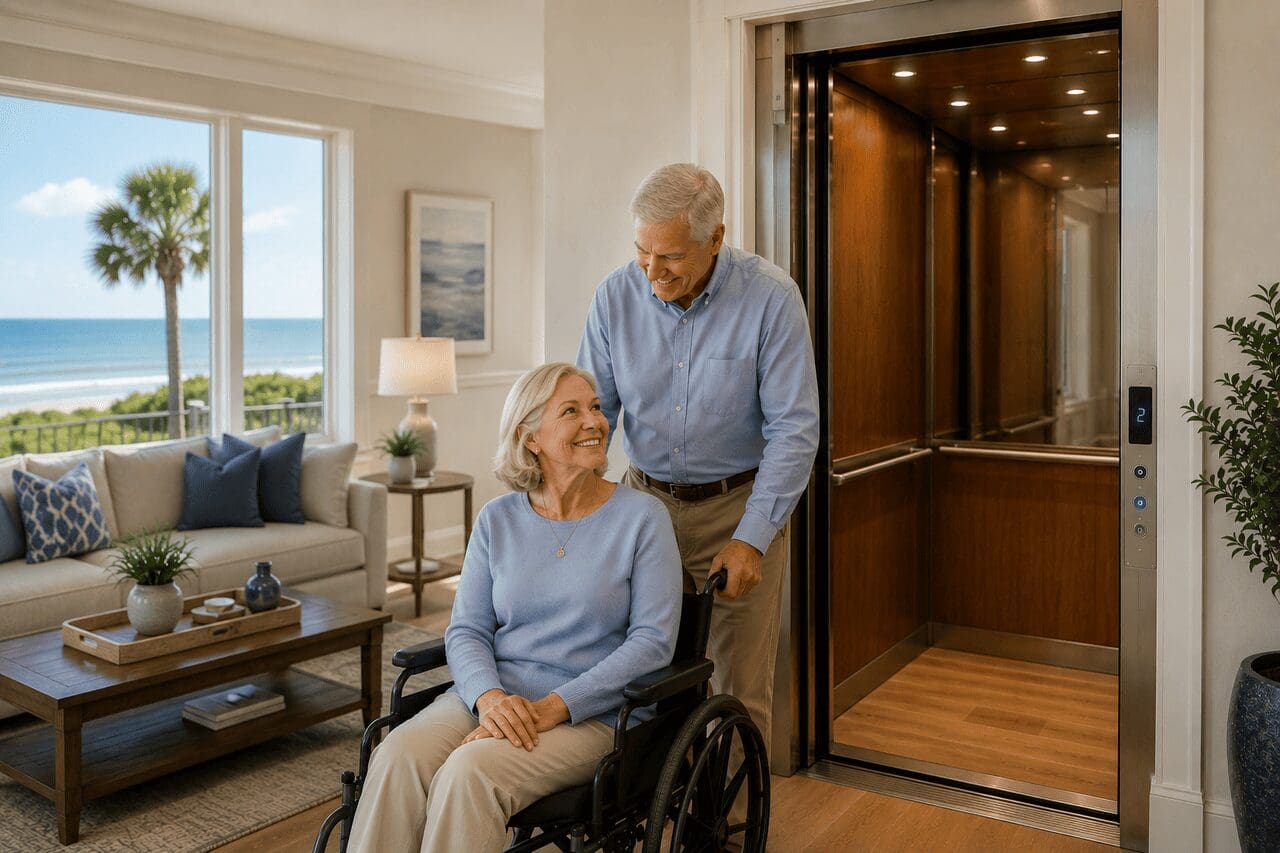
For many homeowners, a coastal home is more than a place to live. It may be the home they spent years building, a favorite gathering place for family, or the property where they hope to enjoy retirement.
But multi-story living can become more challenging as mobility needs change.
Homes throughout coastal South Carolina and Georgia often feature elevated foundations, multiple living levels, long staircases, and raised entrances. While these designs work well for coastal environments and maximize beautiful views, they can make moving around the home increasingly difficult over time.
A residential elevator can help homeowners prepare for the future while continuing to enjoy the home and community they love.
What Does Aging in Place Mean?
Aging in place means designing or adapting a home so that it remains comfortable, accessible, and practical as a homeowner gets older.
Rather than waiting until stairs become difficult to navigate, homeowners can plan ahead by making improvements that support changing mobility needs.
These improvements may include:
- Residential elevators
- Platform lifts
- Stairlifts
- Step-free entrances
- Accessible bathrooms
- Wider doorways
- Improved lighting
- Main-level living spaces
For a multi-story coastal home, access between floors is often one of the most important considerations.
Why Coastal Homes Present Unique Accessibility Challenges
Many coastal homes aren’t built like conventional single-story residences.
In communities throughout South Carolina and Georgia, homes may be elevated to accommodate local building conditions while also taking advantage of ocean, marsh, or water views.
A typical property may include a ground-level garage or entry with primary living spaces located one or two levels above.
That means homeowners could encounter stairs simply to reach:
- The kitchen
- Primary bedroom
- Living room
- Outdoor deck
- Guest rooms
As mobility changes, those stairs can become an everyday obstacle.
Planning for vertical accessibility can help make the entire home easier to use.
How a Residential Elevator Supports Aging in Place
A residential elevator provides convenient access between multiple levels without requiring homeowners to rely exclusively on stairs.
This can become particularly valuable in a home with bedrooms and essential living spaces on different floors.
An elevator can help homeowners:
- Access every level of the home
- Reduce dependence on stairs
- Move groceries and household items more easily
- Accommodate visiting relatives with mobility limitations
- Prepare for future accessibility needs
- Continue enjoying a multi-story home longer
Importantly, homeowners don’t have to wait until mobility becomes limited to appreciate these benefits.
Many families initially use their elevators primarily for everyday convenience.
Plan Before an Elevator Becomes Necessary
Accessibility planning is generally easier when homeowners have time to consider their options.
Waiting until stairs become a serious obstacle can create unnecessary pressure to find an immediate solution.
Planning earlier gives homeowners an opportunity to evaluate:
- Elevator location
- Available space
- Number of floors
- Equipment options
- Construction requirements
- Interior finishes
- Budget
- Future mobility needs
For homeowners building a new coastal home, the design phase is an ideal time to consider an elevator.
Even when an elevator won’t be installed immediately, discussing future accessibility with the architect and builder may create options that make installation easier later.
Retrofitting an Elevator Into an Existing Home
You don’t necessarily need to be building a new house to add a residential elevator.
Many existing homes can accommodate an elevator through a retrofit installation.
Potential locations vary depending on the home’s design and may involve:
- Existing closets
- Interior spaces
- Areas adjacent to staircases
- Additions to the exterior of the home
- Other appropriately designed locations
Every property is different.
An on-site evaluation allows an elevator professional to assess the home’s layout and determine which options may be practical.
Residential Elevator vs. Stairlift for Aging in Place
Both elevators and stairlifts can improve accessibility, but they serve different needs.
A stairlift may work well when:
- Only one staircase needs to be addressed
- The user can safely transfer into the chair
- Extensive construction isn’t desired
- Mobility needs are relatively limited
A residential elevator may be preferable when:
- Several floors need to be accessible
- The homeowner wants greater long-term flexibility
- Multiple family members will use the system
- The home has an elevated primary living level
- The homeowner wants a solution integrated into the property
The right choice depends on the individual, the home, and anticipated future needs.
When a Platform Lift May Be the Better Solution
Sometimes the biggest accessibility challenge isn’t moving throughout the entire home, it’s reaching the entrance.
A vertical platform lift can help wheelchair users and individuals with limited mobility travel between short vertical distances.
Common applications include:
- Raised entrances
- Porches
- Garages
- Decks
- Elevated walkways
For some homeowners, combining an accessible entrance with thoughtful interior planning may provide the right solution.
Think Beyond Mobility
Aging-in-place planning isn’t only about whether someone can climb stairs.
Homeowners should consider how comfortably they can perform everyday activities throughout the property.
For example:
Can groceries be moved from the garage to the kitchen without climbing several flights of stairs?
Can guests comfortably reach the main living areas?
Would someone recovering from surgery be able to access a bedroom?
Could the home accommodate a family member who uses a walker or wheelchair?
Thinking through realistic scenarios can reveal accessibility challenges that aren’t obvious today.
Make the Primary Living Spaces Accessible
A well-planned aging-in-place home should provide convenient access to essential areas.
Ideally, homeowners should be able to reach:
- Primary bedroom
- Full bathroom
- Kitchen
- Main living area
- Exterior entrance
- Laundry area
If these spaces are distributed across multiple levels, an elevator can help connect them.
This can allow homeowners to retain the layout and views they enjoy without making stairs the only way to move through the home.
Don’t Overlook Bathroom Accessibility
Bathrooms are another important component of long-term planning.
Potential accessibility improvements include:
- Curbless showers
- Grab-bar reinforcement
- Non-slip flooring
- Wider doorways
- Handheld shower fixtures
- Accessible vanities
These features can be incorporated into attractive luxury bathroom designs without making the space feel clinical.
If you’re renovating while installing an elevator, it may be a good opportunity to evaluate accessibility throughout the home.
Accessibility Can Still Complement Luxury Design
Some homeowners worry that accessibility modifications will change the character of their home.
That doesn’t have to be the case.
Modern residential elevators can be integrated into high-end interiors using finishes such as:
- Hardwood panels
- Custom flooring
- Glass
- Decorative fixtures
- Stainless steel accents
- Coordinated lighting
When accessibility is considered during the design process, functional features can become a natural part of the home’s architecture.
Consider Guests and Multi-Generational Living
Accessibility improvements aren’t only for homeowners.
Coastal properties often become gathering places for children, grandchildren, parents, friends, and extended family.
An elevator can make the home easier to navigate for guests of different ages and abilities.
It can also support multi-generational living if an older parent eventually moves into the home or spends extended periods there.
Planning for these possibilities can make a property more flexible over the long term.
Vacation Homes Can Become Retirement Homes
Many coastal homeowners initially purchase a property as a vacation or second home with the intention of spending more time there later in life.
If that’s part of your long-term plan, accessibility should be considered before retirement.
A home that works perfectly for weekend trips today may feel very different when it becomes a full-time residence.
Evaluating stairs, entrances, bathrooms, bedrooms, and vertical access in advance can help homeowners prepare the property gradually instead of making major changes later.
Coastal Conditions Should Be Part of the Plan
Accessibility equipment installed near the coast must also account for the local environment.
Salt air and humidity can contribute to wear on mechanical and electrical components, particularly when equipment is exposed to outdoor or unconditioned spaces.
When planning an elevator or lift, consider:
- Equipment location
- Interior versus exterior installation
- Moisture exposure
- Maintenance requirements
- Coastal weather
- Long-term service availability
Routine preventive maintenance is especially important for equipment operating in coastal environments.
Planning for Kiawah Island, Seabrook Island, Fripp Island and Beyond
Aging-in-place considerations are particularly relevant in communities where multi-story and elevated homes are common.
Elevator-Lift Systems, Inc. serves homeowners throughout coastal South Carolina and Georgia, including Kiawah Island, Seabrook Island, Fripp Island, Edisto Beach, Charleston, Savannah, and St. Simons Island.
Every home presents different accessibility challenges, so the appropriate solution should be based on the property’s layout and the homeowner’s individual needs.
Create a Home That Works for the Future
You don’t need to know exactly what your mobility needs will look like 10 or 20 years from now.
The goal of aging-in-place planning is to create flexibility.
A residential elevator can help make a multi-story coastal home easier to navigate today while providing an important accessibility option for the future.
Elevator-Lift Systems, Inc. has provided residential elevator and lift solutions throughout South Carolina and Georgia for more than 40 years. Our team installs, maintains, repairs, and modernizes residential elevators while also providing platform lifts, cargo lifts, and stairlifts.
Contact Elevator-Lift Systems, Inc. today to schedule an on-site consultation and explore accessibility options for your coastal home.