
Best Accessibility Upgrades for Multi-Story Coastal Homes
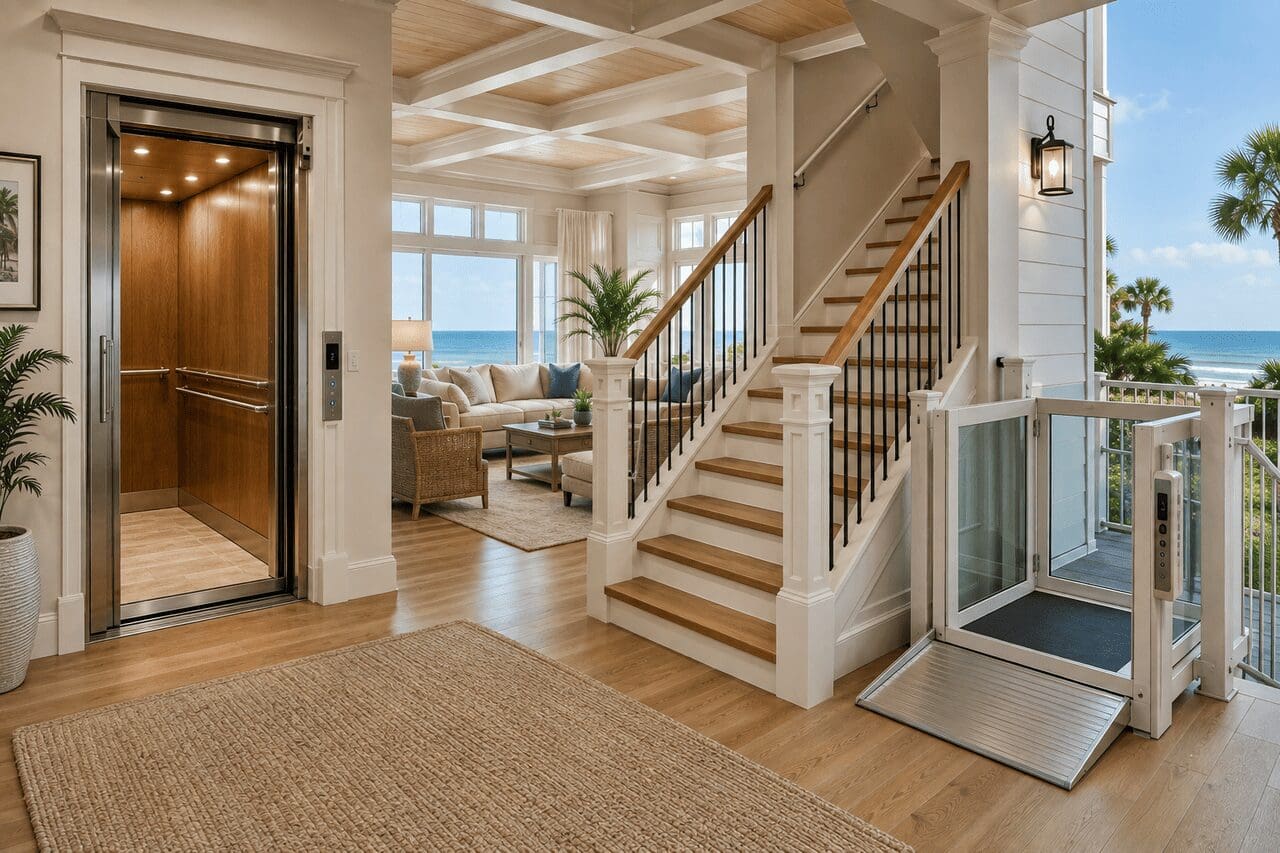
Multi-story coastal homes offer beautiful views, additional living space, and the relaxed lifestyle that makes communities throughout South Carolina and Georgia so desirable. But multiple floors can also create accessibility challenges especially in elevated homes where reaching the main living area may already require climbing a full flight of stairs.
For homeowners planning to age in place, accommodate family members with mobility limitations, or simply make everyday life more convenient, accessibility improvements can significantly increase the long-term usability of a home.
From residential elevators and platform lifts to smaller design changes, here are some of the best accessibility upgrades to consider for a multi-story coastal home.
1. Install a Residential Elevator
For a home with several levels, a residential elevator provides one of the most comprehensive accessibility solutions available.
Instead of relying on stairs to reach bedrooms, living areas, or upper floors, homeowners and guests can move comfortably between levels.
Residential elevators can be particularly valuable in coastal homes because many properties are elevated above ground level. What appears to be a two-story home may require navigating three or more levels from the garage or ground entrance to the upper living spaces.
A home elevator can help:
- Improve access between multiple floors
- Support aging in place
- Accommodate family members with mobility limitations
- Make carrying everyday items easier
- Improve convenience for guests
- Increase the home’s long-term usability
For new construction, planning the elevator during the architectural design stage usually provides the greatest flexibility.
Existing homes may also be candidates for retrofit elevator installations depending on available space and structural conditions.
2. Add a Vertical Platform Lift
Not every accessibility challenge requires a full residential elevator.
A vertical platform lift can provide an effective solution when a homeowner primarily needs assistance reaching an elevated entrance, porch, garage, deck, or another specific level.
Platform lifts are particularly useful for wheelchair users because the individual can remain in the wheelchair while traveling between levels.
Common applications include:
- Elevated front entrances
- Garages
- Porches
- Decks
- Raised patios
- Short vertical distances between floors
For coastal properties with elevated foundations, a platform lift can provide a practical alternative when a traditional ramp would require too much space.
3. Consider a Stairlift
If mobility assistance is only needed along an existing staircase, a stairlift may be the most practical solution.
A stairlift travels along a rail mounted to the staircase and allows the user to move between levels while seated.
Modern residential stairlifts can include features such as:
- Folding seats
- Fold-away footrests
- Safety sensors
- Seat belts
- Battery backup
- Easy-to-use controls
Stairlifts generally require less construction than a residential elevator and can work well for homeowners whose accessibility needs are limited to one staircase.
However, homeowners should consider their long-term mobility requirements. A stairlift that meets today’s needs may not provide the same flexibility as an elevator or platform lift if mobility needs change later.
4. Improve Entryway Accessibility
Accessibility begins before you enter the home.
Many coastal properties have raised entrances because of elevated construction. Steps, thresholds, narrow doors, and uneven transitions can make entering the home difficult for people with limited mobility.
Potential improvements include:
- Wider doorways
- Low or flush thresholds
- Accessible exterior pathways
- Handrails
- Improved exterior lighting
- Non-slip walking surfaces
- Platform lift access where appropriate
When planning a new home, incorporating these features from the beginning can make the entrance more comfortable for everyone without making the home look institutional.
5. Create an Accessible Primary Living Level
One of the most effective aging-in-place strategies is ensuring that essential rooms can be reached easily.
Ideally, homeowners should have convenient access to:
- Primary bedroom
- Full bathroom
- Kitchen
- Main living area
- Exterior entrance
If these spaces are located on different levels, a residential elevator can connect them and help preserve access throughout the home.
In new construction, homeowners should discuss long-term accessibility with their architect before the floor plan is finalized.
6. Upgrade Bathrooms for Accessibility
Bathrooms are among the most important rooms to consider when planning for long-term mobility.
Useful upgrades can include:
- Curbless showers
- Grab bars
- Handheld shower fixtures
- Non-slip flooring
- Wider entryways
- Accessible vanities
- Improved lighting
Even homeowners without current mobility limitations may benefit from incorporating these features during a renovation.
A well-designed accessible bathroom can look every bit as sophisticated as a traditional luxury bathroom while providing greater usability.
7. Widen Important Doorways and Hallways
Narrow doorways can become significant obstacles for someone using a walker or wheelchair.
During construction or major remodeling, consider whether high-traffic doorways and corridors provide adequate clearance.
Priority areas include access to:
- Bedrooms
- Bathrooms
- Kitchens
- Elevators
- Main living areas
- Exterior doors
Planning appropriate clearances during construction is considerably easier than modifying walls and door openings later.
8. Choose Slip-Resistant Flooring
Coastal homes frequently experience wet conditions from rain, pool areas, beach trips, and everyday humidity.
Flooring choices can therefore play an important role in accessibility.
Consider surfaces that provide dependable traction while remaining easy to maintain.
Transitions between different flooring materials should also be kept as smooth as possible to reduce potential tripping hazards.
This is particularly important near:
- Exterior entrances
- Bathrooms
- Kitchens
- Pool access
- Elevator landings
9. Improve Lighting Throughout the Home
Good lighting is a simple accessibility improvement that can make a substantial difference.
Staircases, hallways, entrances, elevator landings, and exterior pathways should be well illuminated.
Consider:
- Motion-activated lighting
- Illuminated switches
- Stair lighting
- Night lighting
- Improved exterior lighting
These upgrades can make navigating the home easier, particularly at night.
10. Install Easy-to-Use Door Hardware
Small details can have a surprisingly large impact on accessibility.
Lever-style door handles are often easier to operate than traditional round knobs, particularly for individuals with limited grip strength.
Similar considerations can be applied to:
- Cabinet hardware
- Faucets
- Light switches
- Elevator controls
- Exterior doors
Universal design focuses on making a home easier for everyone to use, not simply responding to a specific disability.
11. Consider a Residential Cargo Lift for Everyday Convenience
A cargo lift isn’t designed to transport passengers, but it can make life in an elevated coastal home considerably easier.
Homeowners can use cargo lifts to transport items such as:
- Groceries
- Luggage
- Laundry
- Coolers
- Beach equipment
- Fishing gear
- Golf clubs
- Household supplies
Reducing the need to carry heavy items upstairs can be especially helpful for older homeowners or anyone with physical limitations.
It’s important to remember that cargo lifts are for transporting goods not people.
12. Plan for Backup Power and Emergency Situations
Coastal homeowners should also consider how accessibility equipment will function during power outages and severe weather.
Depending on the equipment, certain systems may include battery backup or emergency lowering features.
Homeowners should understand:
- What happens during a power outage
- How emergency features operate
- Where emergency instructions are located
- Who to contact if the equipment stops working
Never attempt to repair or manually override residential elevator equipment without professional guidance.
13. Think About Aging in Place Before You Need To
One of the biggest mistakes homeowners make is waiting until mobility becomes a problem before considering accessibility.
Planning ahead gives you more choices.
During new construction or a major renovation, homeowners can incorporate features such as:
- Elevator shafts
- Wider doorways
- Accessible bathrooms
- Step-free entrances
- Reinforced walls for future grab bars
- Accessible primary suites
Some features can be incorporated into the design now even if they won’t be needed immediately.
This approach can help homeowners remain comfortably in the property they love as their needs change.
Accessibility in Coastal Communities
Homes in communities such as Kiawah Island, Seabrook Island, Fripp Island, Edisto Beach, St. Simons Island, Savannah, Charleston, and other coastal areas often present unique accessibility challenges.
Elevated foundations, multi-story layouts, outdoor living spaces, and long staircases are common architectural features.
The right accessibility solution depends on:
- Home layout
- Number of floors
- Current mobility requirements
- Future accessibility goals
- Available space
- Coastal exposure
- Budget
- Whether the home is new construction or existing
There isn’t a single solution that’s right for every property.
Which Accessibility Upgrade Is Right for Your Home?
For homeowners who need complete access between several floors, a residential elevator may provide the greatest long-term flexibility.
For shorter vertical distances or wheelchair access to an elevated entrance, a platform lift may be more appropriate.
For a single staircase, a stairlift may provide a simpler solution.
And for homeowners who primarily want help moving heavy items between levels, a cargo lift can significantly improve everyday convenience.
A professional assessment can help determine which option best fits your home’s layout and your family’s needs.
Make Your Coastal Home Easier to Enjoy for Years to Come
Accessibility improvements aren’t only about solving today’s mobility challenges. They’re about making your home more comfortable, convenient, and usable throughout different stages of life.
Elevator-Lift Systems, Inc. has helped homeowners throughout South Carolina and Georgia improve residential accessibility for more than 40 years. We install and service residential elevators, platform lifts, cargo lifts, and stairlifts while working with homeowners, builders, and architects to find solutions suited to each property.
Contact Elevator-Lift Systems, Inc. today to schedule an on-site consultation and explore the right accessibility solution for your coastal home.